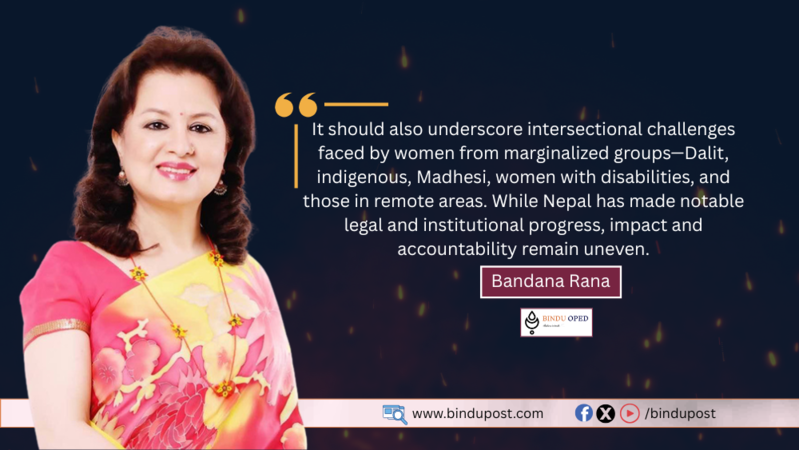
Bindu-Oped correspondent and columnist Saurav Raj Pant recently interviewed Bandana Rana, a veteran women’s rights activist who has been involved for decades in the women’s movement and the United Nations CEDAW process. The conversation focused on women’s rights and their underlying dimensions, following her recent appointment as Country Expert and Rapporteur for Afghanistan. Presented below is the edited excerpt of that discussion.
With your decades of involvement in the CEDAW process, how would you describe your current experience serving as Country Expert and Rapporteur for Afghanistan, and how has this role shaped your understanding of women’s rights challenges globally?
Serving as Country Rapporteur for the CEDAW Constructive Dialogue on Afghanistan has been both a profound responsibility and a personal journey of learning. It has deepened my appreciation of the extraordinary resilience of Afghan women, who continue to advocate for their rights despite systemic oppression and the collapse of formal state protection. It has also highlighted the urgent need for international community and treaty body mechanisms like CEDAW to remain responsive and principled when state actors fail in their obligations. The Committee’s decision to proceed with the review, even in the absence of the de facto authorities—whose legitimacy the UN does not recognize—was a powerful call to action. It sent a clear message: upholding the rights of women and girls is a matter of collective global accountability, not political convenience.
Focusing on Afghanistan, what has been the most striking aspect of the current crisis for women there, and why do you believe it demands urgent and sustained international attention?
The most striking—and heartbreaking—aspect of the crisis is the systematic erasure of women and girls from public life. Their exclusion from education, employment, mobility, and political participation is dismantling of rights and a grave humanitarian crisis. It is unprecedented in both scale and intent. The international community must maintain diplomatic and moral pressure, support Afghan women-led movements, and ensure that women’s rights remain at the heart of any humanitarian or political engagement with Afghanistan.
Based on your experience, what practical measures can countries like Nepal adopt to prevent and respond to forced marriage and trafficking, particularly among vulnerable communities?
Countries like Nepal must adopt a comprehensive approach that balances prevention with protection. This means addressing root causes—poverty, harmful traditional practices, gender norms, discrimination, and lack of access to education, especially among marginalized communities. Legal reforms must be backed by rigorous implementation, gender-sensitive law enforcement, free legal aid, and survivor-centered support services. Regular monitoring and accountability are essential. Cross-border cooperation is critical, especially in trafficking-prone regions. Just as important is meaningful engagement with civil society and affected communities, and increasing women’s participation in governance and decision-making processes.
For audiences in Nepal and the broader region, could you explain how CEDAW actually works in practice to promote women’s rights and eliminate discrimination?
CEDAW is both a legal instrument and an accountability mechanism. States that ratify the Convention are legally bound to submit periodic reports. These are reviewed in a Constructive Dialogue with the Committee, informed by shadow reports from civil society and national human rights institutions. Based on this process, the Committee issues Concluding Observations—concrete, country-specific recommendations to eliminate discrimination and close gender gaps. CEDAW also provides General Recommendations, handles individual complaints, and can initiate state inquiries in cases of grave or systemic violations. In essence, it holds states accountable while offering a clear roadmap for action grounded in human rights and gender equality.
Nepal is preparing to submit its Universal Periodic Review report to the UN Human Rights Council. What key issues concerning the status of women should Nepal emphasize in this process?
Nepal’s UPR submission should highlight the persistent implementation gap, especially in combating gender-based violence, improving access to justice, and addressing harmful practices. It should also underscore intersectional challenges faced by women from marginalized groups—Dalit, indigenous, Madhesi, women with disabilities, and those in remote areas. While Nepal has made notable legal and institutional progress, impact and accountability remain uneven. The UPR process is a critical opportunity to reaffirm commitments with measurable outcomes. Recent recommendations from the CEDAW Committee (February 2025) should be fully integrated into Nepal’s report and follow-up actions.
Finally, how can meetings like these in Geneva help accelerate progress, strengthen accountability, and ensure that recommendations translate into real improvements on the ground?
Geneva is where global norms meet national realities. These meetings are more than formalities—they create vital spaces for dialogue, peer review, and civil society participation. They amplify local voices, expose injustices, and mobilize global solidarity. However, the real test lies in translating recommendations into political will, resource allocation, and institutional reform. Follow-up is key. For me, these meetings are part of a dynamic journey—from local to global and global to local. I carry the lived experiences of communities to the global stage and bring back the global jurisprudence to inform local action. That is how we make rights real.