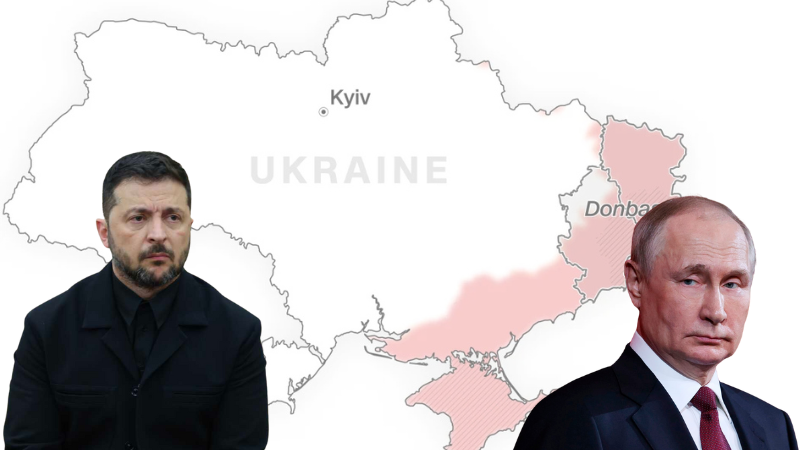
In this Russia-Ukraine war, the eastern region of Ukraine that includes, Donetsk and Luhansk have been the core agenda of peace deal. Russia wants it at any cost, including Kyiv-held cities like Kramatorsk and Sloviansk. For Ukrainians, these lands are not just about national pride but also emotional and personal. During President Zelenskyy interaction with President Trump, he said that the Donbas region was the place where his grandfather had fought in World War II to free the cities from the Nazis. He could not just give it up.
This region is equals to the size of the West Virginia in the US; it is mineral-rich and strategically vital for the Russia to block Ukraine’s NATO/EU aspirations. Russia is moving ahead to seize the 2,500 sq. miles still held by Ukraine. President Putin seeks to politically weaken and potentially topple President Zelensky by demanding to cede land for Russia.
Constitutionally, the Ukrainian land cannot be given to Russia because there is a clear prohibition. Moreover, most Ukrainians oppose any concession. Yet President Putin has signaled that Ukraine must cede land to Russia as a first condition for negotiations.
President Trump has a plan for land-swaps deal ceding Donbas in exchange for peace and possible small territorial returns elsewhere. President Trump is making it like a business deal, but this is a political issue tied to land. European leaders, in return, are looking for strong security guarantees, though it is unclear whether Russia would accept them.
The ongoing situation points toward “trade land for peace” between Ukraine with Russia. However, by ceding Donbas, Ukrainians fear enabling a future Russian invasion. Many European analysts claim that, Ukraine still holds leverage, but Russia’s slow advances, any land-for-peace deal could weaken Kyiv further.
Looking back at history, Crimea was annexed by Russia in 2014. In the same year, Russia began backing Donbas separatists’ group. In 2015, the Minsk accords were discussed for autonomy of Donbas, but Russia demanded to veto power over Kyiv’s policies. In April 2019, Zelensky was elected as a President and had talk with Putin in Paris (December 2019). This talk failed resulting to the full-scale Russia-Ukraine war began in 2022.
In the current context, Ukraine remains unwilling to concede, while Russia remains unwilling to compromise. Trump is pushing for a deal, but Ukraine risks domestic backlash.
In summary: For the U.S. and Europe, the main focus is whether peace can be secured through territorial compromise plus security guarantees. The outcome of peace talks remains uncertain, and all paths circle back to Donbas. Yet “more fighting” still appears the likely near-term reality.