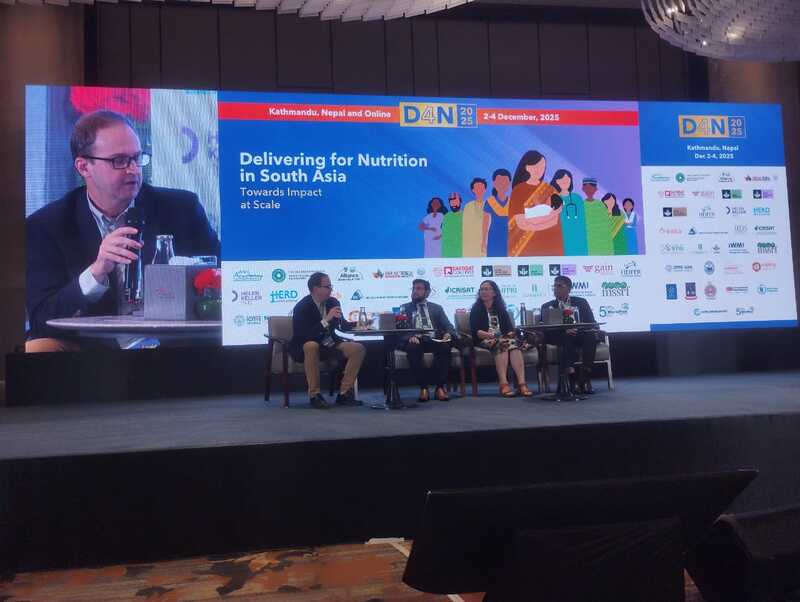
The session “Achieving Impact at Scale to Improve Nutrition in South Asia: Learnings from Consumer, Centric Approaches” was included in the conference “Delivering for Nutrition in South Asia: Towards Impact at Scale” and organized on December 4th, 2025, in Kathmandu, Nepal. The International Food Policy Research Institute (IFPRI) was the organizing entity for this session.
The learning objective of this session was stated as creating awareness of the importance of diets and food system transformation for nutrition, showcasing two distinct approaches toward better diets and nutrition: one which focuses on the whole diet through policy pathways and a market systems perspective, and the other that takes an end-to-end approach, using the vegetable value chain to influence policies in general to improve the whole diet, and fostering interest and commitment among conference participants to engage in the food systems agenda in their country/regional contexts using their own unique viewpoints.
Before the start of the plenary session, some slides were shown regarding the challenges in diets. They mentioned that unaffordability, large environmental footprints, climate change and vulnerability, conflicts, and economic shocks are affecting the food on the table.
During the slide show, Dr. Inge Brouwer talked about the 2030 goal, that is mainly about consumers demanding and consuming accessible, affordable, available, safe, and desirable sustainable healthy diets. Moreover, she indicated that there are three ways to do this, namely, by meeting needs, co, designing research-based solutions, and creating impact. In the “Responding to Needs” section, food system challenges and demand for solutions were covered; then policies that transform (National Action Plans for Food System Transformation) and solutions that count (the end-to-end approach of nutritious food) lead to impact generation were shown in the slide.
Then, the presentation continued with a slide showing Sustainable Healthy Diets Through Food Systems Transformation (SHiFT), in which demand-side aspects of the food system and food environments were mentioned through strengthening evidence-based policy formulation and guiding strategies to improve food security and nutrition through food system transformation. While giving an instance, the speaker pointed out that the food system has been harmonized with the national policies and plans of Bangladesh which comprise the Second Country Investment Plan for Nutrition, Sensitive Food Systems (2016-2020), and the Third CIP for Sustainable, Nutrition, Sensitive, and Resilient Food Systems (2021-2025). Besides this, there were deliberations on the food system’s additional policy avenues such as training, the Food System Innovation Lab, and the food environment.
There were desirability, availability, affordability, and accessibility factors discussed during the session. Upon being questioned about the barriers to sustainable healthy diets, participants responded that these are significantly affected by policy and governance. To solve these problems, the comprehensive method covering demand, the food environment, and supply was suggested. All of which are influenced by the enabling environment, including partnerships, policies, capacity building, and knowledge sharing.
Then the session moved into the panel discussion. The panel discussion was moderated by Alan de Brauw (Senior Research Fellow at IFPRI). At the beginning of the session, Alan invited the speaker from Vietnam for her insights. She talked about food severity, hunger, and low diet quality. According to her, collaboration with the Consultative Group on International Agricultural Research (CGIAR) and local partners to understand consumption, the supply chain, and healthy diets is necessary for food system transformation. She also mentioned that there is a need for a multi-sectoral approach comprising agriculture, health, and climate sectors from national to provincial to local levels.
During the session, it was shared that food and nutrient consumption in Sri Lanka is far below WHO recommendations. The speaker emphasized behavior and market access as the main aspects of their ongoing work in Sri Lanka.
The speaker from Bangladesh described the private sector’s engagement model and also highlighted the need for food fortification to solve micronutrient deficiencies.
The final key takeaway was shared by the moderator quoting; consumer confidence is what matters most for the consumption of healthy food.