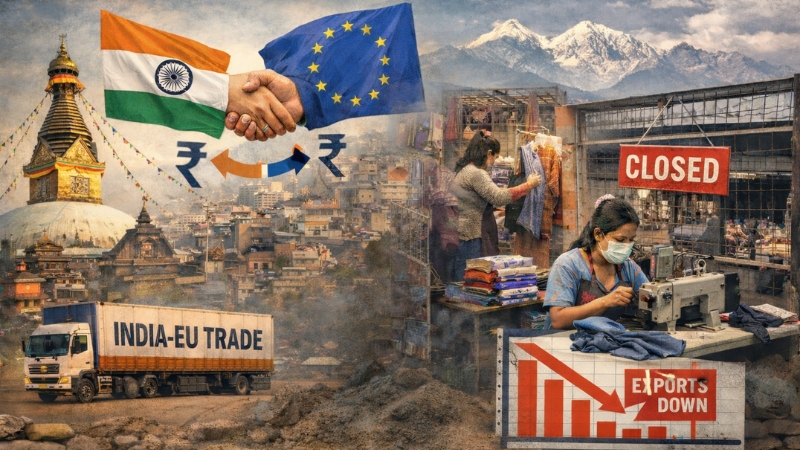
The India-EU Free Trade Agreement (FTA) was signed in January 2026 after nearly two decades of prolonged negotiations. The agreement aims to eliminate tariffs on more than 90 percent of the total trade value between India and the European Union (EU). By reducing trade barriers, the FTA is expected to enhance market access for both sides and deepen economic integration between two of the world’s largest economies.
Both India and the EU stand to gain from the agreement. But it also has major repercussions for other countries like Nepal who has a close market integration; makes it very sensitive to this change.
Key Provisions of the India-EU FTA
With the pact, India would get an instant tariff free access to 70. 4 % of the lines, which account for 90. 7 % of exports to the EU. The tariff free sectors are textile and garments, leather and footwear, tea, coffee and spices, sports goods, toys, jewelry, precious stones, and certain marine products.
Phased zero-tariff access will be granted within three to five years on 20.3 % of tariff lines, accounting for 2.9 % of exports. These include processed food items, selected marine products, and arms and ammunition. Further tariff reductions and preferential access will apply to 6.1 % of tariff lines, covering 6 % of exports, including poultry products, preserved vegetables, bakery items, automobiles, steel, shrimp, and prawns.
India’s textiles and apparel sector will receive zero-duty access across all textile and clothing tariff lines in the EU’s USD 263.5 billion import market, with tariff reductions of up to 12 %.
From the EU’s side, India will reduce tariffs on cars from 110 % to as low as 10 %. This remaining 10 % tariff on car parts will be fully abolished within five to ten years. In addition, tariffs of 44 % on machinery, 22 % on chemicals, and 11 % on pharmaceuticals will be largely eliminated.
Implications for Nepal
Nepal not being a direct party to the India-EU FTA, does not diminish the indirect ramifications of the agreement on Nepal. Nepal annually exports ready, made garments worth nearly NPR 6 billion to the European countries although the export figure has been going down over the years. Since India has obtained the privilege of tariff, free access to the EU market for garments and textiles, Nepal’s exports will probably face stiff competition from Indian manufacturers.
Automobiles and dairy, along with other non, garments sectors, may also be areas of trade that could experience fluctuations as Indian products get more competitive in the EU market. These developments might have an indirect impact on Nepal’s domestic industries through price competition and market displacement.
Moreover, the agreement sets a new benchmark for the EU regulatory, standards, and requirements. As India moves towards a closer alignment with EU norms, Nepal might face the challenge of having to fulfill similar standards so as to keep its market access and be competitive.
Nepal’s LDC Graduation and Trade Preferences
Nepal currently benefits from the EU’s “Everything But Arms” (EBA) scheme. This provides tariff-free access of its exports. In November 2026, Nepal is scheduled to graduate from Least Developed Country (LDC), these preferential benefits may no longer apply.
Nepal will need to either seek adjusted preferential terms under the EU’s Generalized Scheme of Preferences Plus (GSP+) or explore the possibility of a bilateral trade agreement with the EU in Post-graduation period. Although a three-year transition period is available but early negotiations are crucial to secure favorable market access and avoid export disruption. In aligned with domestic production, labor, environmental, and regulatory standards with EU requirements will be essential for Nepal to remain competitive in the post-LDC context.
Ratification Timeline
The legal and approval procedures for India-EU FTA on both sides is expected to be fully ratified and enter into force by early 2027. This timeline coincides closely with Nepal’s LDC graduation. It has increased the urgency for Nepal to assess and respond strategically to the agreement’s potential impacts.
Expert Perspective
Former Finance Secretary Madhu Marasini emphasizes the importance of proactive engagement, stated that, “Nepal’s dependence on the Indian market for both exports and imports are making us essential to take a close and thorough look at the FTAs. Nepal is graduating from the LDC in November 2026. So far, we have been enjoying the benefits of the EUs EBA scheme, but post, graduation, we will have to transition to GSP+.”

He further added that, “Even though we will be given a three-year period of adjustment, the negotiation ahead of the time will be a crucial factor. The FTAs of India; first with the UK and presently with the EU; are a demonstration that Nepal needs to get connected directly and indirectly to India’s various value chains in order to avoid negative impacts from such FTAs.”
In addition to this, Senior Economist and former senior advisor at the Ministry of Finance, Dr. Posh Raj Pandey, stated that, “It is now time to focus on the domestic Nepali market for garment supply. Business communities of Nepal relying only on foreign markets makes Nepal vulnerable to changing global economic and political conditions, such as the India-EU FTA. Domestic producers should begin researching the needs and preferences of Nepali consumers in order to make their businesses more sustainable.”

Bhojraj Poudel, economist and Chairman of the Institute for Future, stated that the, “India-EU FTA, or any other global economic development, should not be viewed in a reactionary manner. He emphasized that it is the responsibility of dedicated institutions to take charge and maintain a close watch on ongoing global events. While experts and the media can provide valuable inputs, substantive and lasting change can only be driven by specialized institutions mandated to work on economic and trade sectors. Therefore, it is necessary to strengthen the capacity of these institutions, review the politically appointed personnel working within them, and establish provisions to hire experts and technocrats who can effectively guide and lead the system.”

Overall Assessment
The India-EU FTA marks a significant change in the dynamics of trade at both the regional and global levels. For Nepal, this agreement is a wake, up call for the need of early strategic planning, more profound integration into regional value chains, compliance with the EU regulations, and active trade diplomacy as the country is about to graduate from LDC status.