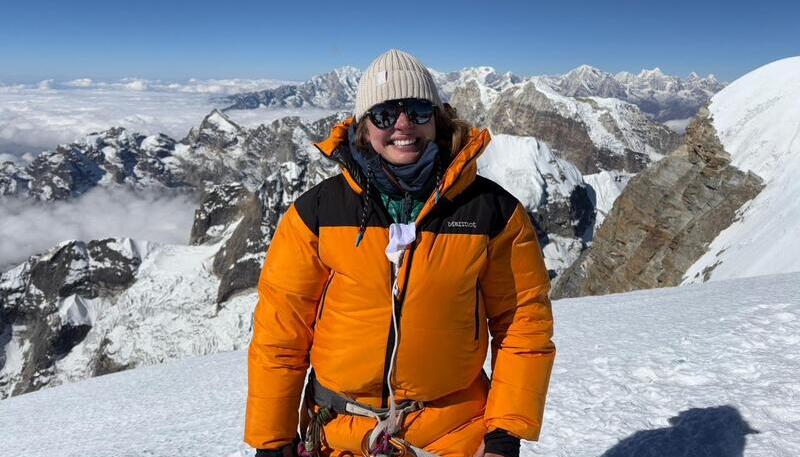
Pakenaite Karolina, 30, is a differently-abled woman with hearing and visual impairments. Despite these challenges, she embodies remarkable motivation, passion, and courage—serving as an inspiration to many other differently-abled individuals. She has a strong passion for mountaineering and has successfully climbed Mount Kenya in Africa, Mera peak (6476m) and Himlung Himal (7126m) in Nepal, and now she aims to summit Mount Everest. In this context, our Foreign Affairs and Economic Columnist, Saurav Raj Pant, spoke with her about her background, plans, inspirations, dreams, and future goals.
1. Please tell me about yourself.
I was born in Lithuania and moved to the UK during my childhood with my parents. I have a PhD in Computer Science. I was born hard of hearing, and by the age of 18, my vision also began to deteriorate.
2. Did your special needs lead to any different treatment from friends or classmates in the UK?
I wouldn’t say that I was directly discriminated against, but I would say that people often struggled to understand my needs. The Equality Act in the UK ensures that people with disabilities receive the necessary support and protection, which has made a big difference in my life.
For daily mobility, I rely on my guide dog, a cross between a Golden Retriever and a Labrador. In the UK, guide dogs are legally permitted in restaurants, hotels, and most public places, which makes everyday life much easier. I have a very strong bond with my dog—it’s my first one—and it will turn 10 in January 2026. It will be difficult to let him go when he retires, as he’s been such an important part of my sight loss journey.
3. Do you face difficulties in using websites or digital services?
I don’t face major difficulties with websites in general, but accessibility can vary a lot. Some websites don’t follow accessibility standards—like missing alt text for images, poor colour contrast, or complicated layouts that screen readers can’t interpret well. Videos without subtitles are particularly challenging because of my hearing impairment, and flashing visuals can be uncomfortable for my eyes.
4. Please tell me about your mountaineering journey.
Three years ago, I trekked to Everest Base Camp. During that trip, I learned that a deaf climber had already reached the summit, which inspired me to aim higher—I want to become the first deafblind person to climb Mount Everest.
Since then, I’ve successfully climbed Mount Kenya, summited Himlung, which stands over 6,000 metres, and trekked to Poon Hill. Each expedition has strengthened my confidence, resilience, and belief that with the right team and preparation, Everest is within reach.
5. What is your primary aim in life?
My main goal is to experience and see as much of the world as I can, as my vision gradually declines. I also want to remain as independent as possible throughout my life.
In addition, having earned a PhD in Computer Science from the University of Bath, I hope to continue my research through post-doctoral work. I am planning to apply for a research grant to develop a device that enhances tactile communication and navigation—particularly for use in mountaineering.
6. Do you feel differences between men and women facing similar physical challenges?
I believe both men and women with disabilities face largely the same physical challenges in adventure sports, but the social and cultural expectations may differ. I think women often find themselves needing to prove their capability or negotiate space in what has been a male-dominated domain. For instance, gear and expedition roles were historically designed with men in mind, which adds an extra layer of effort. Thankfully, my training team has always treated me as an equal and focused on ability rather than gender.
7. Are you currently training for your Everest expedition?
Yes. I am currently training under Krishna Thapa, a former SAS soldier and Gurkha with extensive experience leading high-altitude expeditions. He has been instrumental in helping me prepare both physically and mentally for this challenge. His background in elite military and mountain leadership brings a unique perspective to my training, especially in building resilience, discipline, and teamwork.
8. What do you usually do during your visits to Nepal?
This is my fourth visit to Nepal. Whenever I’m here, I love exploring Thamel, volunteering at a deaf school in Pokhara, or visiting deafblind communities in Kathmandu. The students and community members truly inspire me—they show remarkable determination and joy despite having limited resources.
9. What kind of support do you expect from your expedition team on climbs?
Communication and mutual trust are everything on the mountain. Since I can’t always depend on sight or sound, my guides and I use touch-based communication—simple cues like taps on the shoulder, hand pressure, or a guiding rope—to signal direction, obstacles, or changes in pace. These subtle interactions become our language on the mountain. It’s about deep trust and awareness; every step requires coordination and shared understanding.
10. Is there anything you would like to add to this interview that we may have missed?
Teamwork is absolutely essential in mountaineering. Reaching the summit is never just an individual achievement—it’s the result of trust, coordination, and shared determination. I’m deeply grateful to my expedition team for their constant support and belief in me.