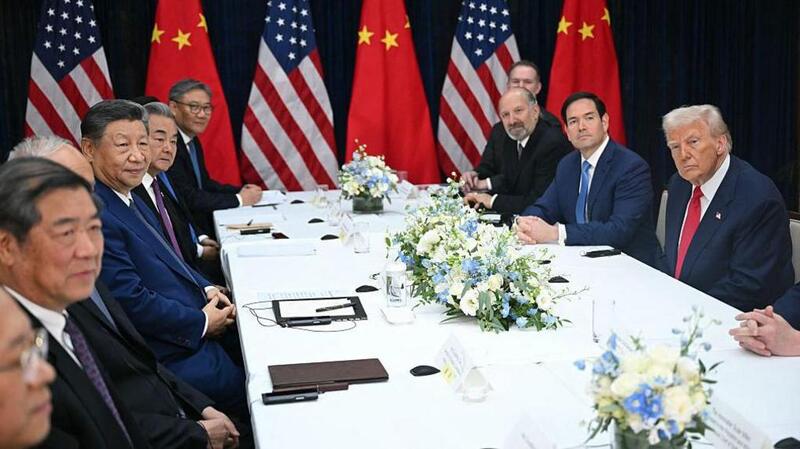
The US President, Donald Trump, and the Chinese President, Xi Jinping, held a bilateral meeting in Busan, South Korea, on the sidelines of the APEC summit. During the meeting, both presidents emphasized the importance of relations between the two world’s leading economies. As Chinese President Xi stated, China and the US are partners, not rivals, despite the fact there exist a difference. During the meeting, Xi’s core message to Trump was that the Chinese economy is growing, and in the first three quarters, the growth rate was 5.2%. During his interaction with Trump, Xi delivered a line stating, “The Chinese economy is like a vast ocean—big, resilient, and promising. We have the confidence and capability to navigate all kinds of risks and challenges.” In response, President Trump’s core message was that Xi is a long-time friend and a respected leader, and that China and the US together can achieve major global outcomes.
In terms of trade and economic cooperation, both sides disclosed that they had reached a consensus on reducing tensions. They have shortened the list of problems, and lengthen the list of areas for cooperation. During the Trump-Xi meeting in Busan, areas for practical cooperation mentioned by the Chinese side included anti-money laundering, AI governance, public health (disease response), combating illegal immigration and telecom fraud, and regional and global coordination.
Key Trade Negotiation
US President Trump told reporters that the meeting was a “12 out of 10,” and Beijing described the results as “hard-won.” He further stated that the overall tariff on China would be reduced from 57% to 47% after the meeting with Xi, though it remains unclear how this figure aligns with the 55% previously announced in June 2025. Trump also said that the US would cut the fentanyl tariff on Chinese goods entering the US from 20% to 10%. In return, the Chinese side would start purchasing massive amounts of soybeans and other farm products. Additionally, the Chinese side expressed that the US would be able to buy rare earths more easily from China.
According to the White House, China’s major commitments during the Xi-Trump meeting in Busan included: stopping fentanyl precursor exports to the US through tighter controls on chemical shipments; removing export restrictions on rare earths and critical minerals (gallium, germanium, antimony, graphite), effectively reversing previous restrictions imposed since 2023; ending retaliation against US semiconductor firms and removing US companies from China’s “unreliable entity” lists; and suspending all retaliatory tariffs introduced since March 2025, especially those targeting US soybeans, pork, beef, grains, fruits, dairy, and aquatic products. China also agreed to purchase 12 MMT of US soybeans by the end of 2025 and 25 MMT annually from 2026–2028, as well as to resume imports of sorghum and US timber products. Furthermore, China agreed to allow the resumption of chip production at Nexperia facilities to maintain the global supply of legacy semiconductors, end investigations targeting US semiconductor and supply-chain companies, and extend tariff exclusion allowances for US imports through December 31, 2026.
In response, the US made a major commitment to reduce tariffs on Chinese imports linked to fentanyl enforcement by removing 10 percentage points from the cumulative rate, effective November 10, 2025. In addition, the US will pause further tariff escalation on Chinese imports until November 10, 2026 (maintaining the base 10% reciprocal tariff), extend Section 301 tariff exclusions until November 10, 2026, suspend controls targeting Chinese firms’ affiliates in US end-user export restrictions for one year, and pause new measures from the Section 301 shipbuilding sector investigation for one year, while pursuing negotiations and coordinating industrial policy with South Korea and Japan.
Key Ideological Lines of the US–China Trade War
The ideological lines of the US-China trade war span several sectors, including but not limited to: national security and sovereignty, economic nationalism versus global engagement, rule of law and reciprocity, trade as a tool of negotiation and diplomacy, global leadership and responsibility, conflict versus dialogue, and market access and reciprocity.
For the US, trade and tariffs are meant to protect its economy, strengthen domestic industries particularly semiconductors, shipbuilding, and rare earths while China believes in defending its economic sovereignty against any imposed tariffs. The current US administration focused to the “America First” policy by safeguarding jobs, farmers, and families. It has been using tariffs as leverage. On the other hand, China is advocating for reform and opening up. It also urged for global cooperation as well as framing US-China cooperation as mutually beneficial rather than zero-sum. The US positions herself as the safeguard of the global order by protecting domestic interests and seeking allied cooperation (such as with Japan and South Korea), for strengthening leverage. China positions itself as a responsible global power, willing to share development opportunities while defending national interests.
Conclusion
By examining the overall tariff policies executed by US President Trump during his second presidency reveals that tariffs were meant to build pressure on China. It was meant to bring it to the negotiation table. They were not intended to decouple the two economies nor serve as a long-term economic policy. China responded with retaliatory measures while considering that further destabilization of relations with the US could harm its own growth momentum, showing limited scope for long-term sustainability of these measures.
Although the tariffs make global headlines, the eventual stabilization around a negotiated middle range indicates that both countries are managing the trade war through negotiation rather than moving toward complete decoupling. Both countries initiated a strategy of controlled rivalry, where pressure and dialogue operate together.
A few days before the Xi-Trump meeting in Busan, the US-Japan agreement on $550 billion in investments (in the US by Japan) for managing, producing, and securing supply chains, as well as coordinating on critical minerals, demonstrates that Trump effectively engaged both sides—Indo-Pacific partners and rival China.