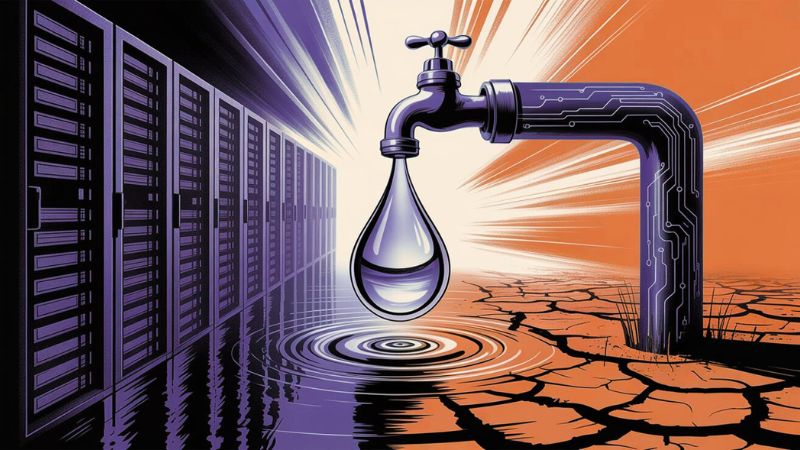
India’s data center sector is booming because of the country’s massive use of the internet and mobile devices, the growth of AI, and the push for local data storage policies. This has resulted in major global investors like Google (USD 15 billion) investing in an AI data center in Andhra Pradesh. India’s data center capacity is projected to increase by 77% by 2027 (to 1.8 GW). However, India generates 20% of global data but has only 3% of global data center capacity. Western investors are interested in setting up data centers in India because of lower electricity costs compared to the US, the UK, and Japan.
But difficulties are also arising in tandem with this enormous advancement. Data center cooling systems need a lot of electricity and water. There has been a projection made about India’s data center, which states that India’s data centers will use 358 billion liters of water by 2030, up from 150 billion liters in 2025. The fact that the nation has 18% of the world’s population but only 4% of its freshwater resources, which are concentrated in already water-stressed areas like Bengaluru, Hyderabad, Chennai, and Mumbai; that complicates matters.
According to an S&P Global study, the 60–80% of data centers in India will experience high water stress as a result of the country’s limited water resources. This could have a domino effect on other industries like banking, healthcare, and cloud services, particularly during the hottest summer months when there isn’t enough water for cooling.
Experts suggest possible solutions, including using treated wastewater instead of freshwater for cooling, choosing low water-stress zones for new projects, adopting zero-water cooling technologies where possible, and mandating renewable energy sourcing to reduce dependence on fossil fuels.