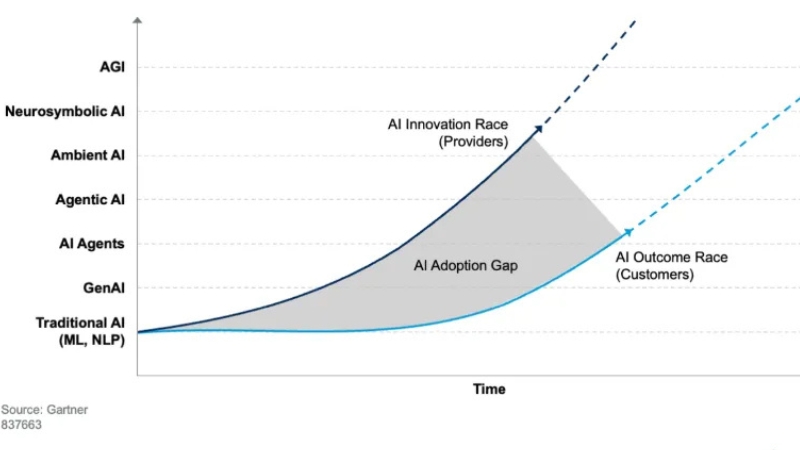
According to research conducted by Gartner on the AI adoption gap, it has been found that innovation in AI is accelerating faster than its adoption. AI developers are moving quickly toward more advanced systems. But customers are lagging behind as organizations struggle to deploy, integrate, and scale it AI effectively.
This widening gap indicates unrealized value, inefficiencies, and missed outcomes. The research also shows that the evolution of AI sophistication is progressing upward from traditional AI to generative AI, including ongoing research in AI agents, and ultimately toward AGI.
The research concerns the reasons behind the widening AI adoption gap is due to the lack of skilled talent and AI literacy. Secondly, there has been a weak data foundations and legacy systems, regulatory, ethical, and governance uncertainties. Thirdly, poor change management and trust issues, and difficulty translating AI capabilities into tangible business outcomes. As a result of these issues, technology is becoming ready faster than institutions can adapt.
In terms of strategic implications for companies and governments, competitive advantage will come from effective execution and integration rather than mere access to AI. Additionally, late adopters risk becoming locked into dependency on AI providers. From the perspective of AI providers, the primary bottleneck is no longer innovation, but adoption.